
Read Our Latest Impact Report

Share this article

Folding Circularity: How FridayBOX Is Rethinking Reusable Packaging, Logistics, and Inclusion

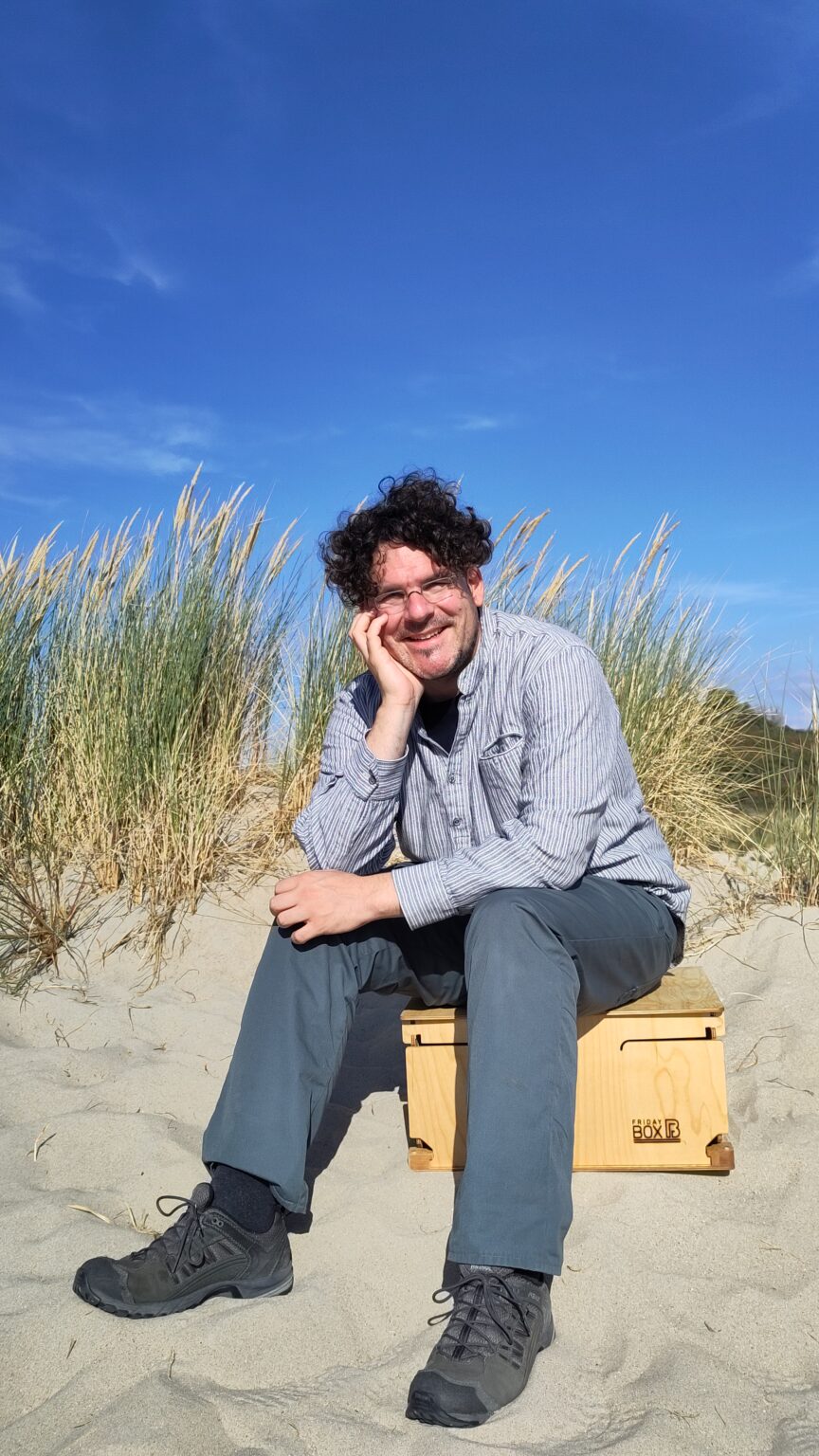
Picture Credits: FridayBOX

FridayBOX, a social business from Germany, is a strong example of how reusable packaging can combine circular design, natural materials and inclusive production.

Introduction

This article is part of the Circular Impact Champion interview series of the Circular Impact Procurement Initiative (CIPI). In this series, we present social businesses with circular solutions that generate ecological and social impact. In each edition, we speak with founders or decision-makers who are creating new pathways for the circular economy in procurement and supply chains.

Through CIPI, we support innovative social businesses that offer circular solutions and thereby advance social and ecological progress. One of these businesses is FridayBOX, a company developing durable, foldable wooden boxes for reusable packaging systems. Designed for logistics loops, retail settings and point-of-sale use, FridayBOX replaces single-use packaging with robust, repairable and space-saving alternatives made from wood.

Our Program Director at Yunus Environment Hub and CIPI lead, Kiara Winona Sweeney, recently met with Michael Vitz, founder of FridayBOX, for a conversation. In the interview, Michael explains how the idea for FridayBOX emerged, how the business applies circular economy principles through repairable design and reusable logistics loops, and how production in cooperation with a workshop for people with disabilities creates social impact alongside ecological value.

Interview

Kiara: What is the business idea behind FridayBOX? What problem does it solve, and what inspired you to start the company?

Michael: The idea emerged from a consulting assignment. The task was to develop a stable, durable foldable box for transporting heavy goods in the last-mile logistics sector. In that context, I realized that there was very little on the market that was truly robust, and certainly nothing made of wood or even designed with a wood-like appearance.

That made me think there was a real gap in the market worth exploring. I started experimenting in my prototype workshop, and fairly quickly a concept began to take shape that made me think, yes, this could actually work. That was the beginning of FridayBOX: a sturdy, foldable wooden box that can be reused many times and adapted to different use cases.

As the idea developed further, it became clear that we were the first to create a foldable wooden crate suitable for industrial applications. We can adjust the dimensions very flexibly. Today, we produce boxes ranging from around 30 × 40 cm up to almost pallet size, such as 1200 × 800 or 1200 × 1000 mm. This means companies can access tailor-made reusable packaging even at relatively small quantities, without having to invest immediately in expensive injection-molding tools.

Kiara: FridayBOX is built on the principles of the circular economy. How do you integrate these principles into your business model in practice, and what strategies define your approach?

Michael: For someone who does not deal with packaging every day, it can be summed up quite simply: we try to build a box that lasts a long time, can be repaired, and does not simply lose its material value at the end of its life.

The key elements are:

  1. Material choice: We use birch plywood from Europe. Not every type of plywood is suitable. Poplar, for example, tends to splinter too much, while beech often warps quite heavily. Birch is technically very well suited because it is strong, dimensionally stable, and still relatively lightweight. We treat the surface with linseed oil. Linseed oil has been used for centuries; it penetrates deeply into the wood and hardens, so the wood structure remains open while being protected against moisture. We add a bit of orange oil to help it dry faster.
  2. Design for repair: The FridayBOX is screwed together rather than glued. This means that if one part breaks, there is no need to discard the entire box. Individual components can simply be replaced. With a Torx bit and a bit of manual skill, the box can be repaired, which significantly extends its service life.
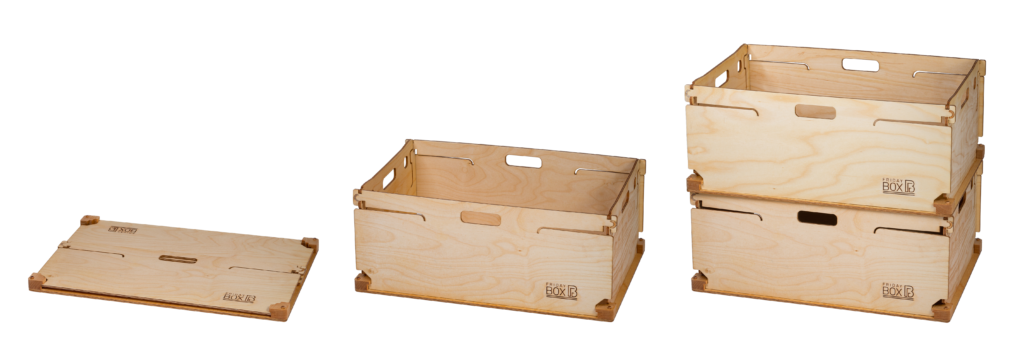
  3. Foldability and use in loops: The box folds down extremely flat. The large models are only around 33 mm high when folded. That saves a great deal of space in storage and during return transport. In reusable systems where boxes circulate between suppliers and production sites, or between warehouses and retail points, this is extremely valuable. Less empty space means fewer transports and lower emissions.
  4. Cascading use of wood: When it comes to the material itself, we are not yet where we would ultimately like to be. Plywood consists of layers of wood pressed together with adhesives. The adhesives commonly available on the market today are neither compostable nor designed in a way that would allow the material to be easily returned to a biological cycle. The industry has been working for several years on bio-based and biodegradable adhesives, but these are not yet widely available.

What we can already do, however, is think in terms of a wood use cascade. Defective parts do not have to be burned immediately. They can be shredded and first turned into particleboard, the kind many people know from furniture such as IKEA shelving. In a further step, these boards can then be processed into MDF or HDF, which are commonly used, for example, as the back panels of cabinets. In this way, the raw material can be used several times materially before finally being used for energy recovery.

Our goal is to make FridayBOX increasingly circular over time, ideally by moving toward bio-based adhesives and panel materials as soon as they become available at reasonable prices and with the right quality.

Kiara: Your product is clearly designed to reduce environmental harm. Could you elaborate on its ecological impact? How does using FridayBOX compare to conventional single-use boxes, and what difference does it make?

Michael: Put very simply, a FridayBOX is designed to survive many, many transport cycles. A single-use box is finished after one use.

We primarily focus on commercial use in logistics loops. One major advantage is that we can customize the boxes, especially in height. This improves packing density: more goods can fit into one box, and therefore more can fit onto a pallet or into a vehicle, without becoming impractical from an ergonomic or logistical perspective.

With conventional plastic containers, that is much more difficult. If you want to change the height, you need a new injection-molding tool, which is extremely expensive. The alternatives are often special solutions such as welded constructions, but those quickly become one-off products. Our boxes, by contrast, can be produced using comparatively simple CNC technology and a standard wood-based material.

A second important factor is foldability:

  • When assembled, the larger boxes measure roughly 40 × 60 × 24.5 cm and hold around 48 liters.
  • When folded, they are only 33 mm high and can be stacked in an extremely space-saving way.

That makes a real difference both in storage and in return transport, including compared to many other foldable boxes on the market, which tend to remain bulkier even when collapsed.

Of course, the product costs more than a simple cardboard box or a thin plastic crate. That is due to the wood material, the manufacturing process, and the fact that we produce in Germany. But when you calculate the cost over many uses, the equation changes. Over its lifetime, one FridayBOX replaces a large number of single-use boxes. That means ongoing resource savings and less packaging waste, while also providing better product protection, since wood is much more robust than thin cardboard.

Kiara: Beyond the environmental benefits, FridayBOX is also a social business. What kind of social impact are you seeking to create through your company?

Michael: One important social aspect is our collaboration with a workshop for people with disabilities. Since the beginning of 2023, we have been producing on our own machines at the Varius workshops, which are part of Lebenshilfe in the Rhein-Kreis Neuss region.

At the beginning of series production, I spent several weeks there every day, closely supporting the team, helping them become familiar with the milling technology, the software, and the workflows, and sharing many practical tips. At the same time, I learned a great deal myself.

It was important to me that this should not become a place where only so-called leftover work ends up, meaning repetitive finishing tasks or activities without visible purpose. With FridayBOX, it is different. We deliver the wooden panels, the screws, and the linseed oil, and a complete product is created on site. The employees can see the entire process, from raw materials to finished box.

Another important point is that not only the supervising specialists, but also employees with disabilities operate the CNC technology. For those who are particularly comfortable with computers, this is a real development opportunity. They work in a carpentry setting, but at the same time use modern digital and machine technology on a daily basis.

We also pay close attention to how manageable the production process is for the people working there. For example, when it comes to surface treatment, we use natural oils instead of complex industrial chemicals, and the work steps are clear and straightforward. People should not need to be engineers to contribute meaningfully to this product.

Kiara: In your view, who benefits most from your solution? Could you describe your ideal customer and share a few examples of how clients use your reusable packaging?

Michael: You need the right use case for FridayBOX. Ideally, it fits into a closed logistics loop where the boxes circulate, for example between a warehouse and a market stall, or between production and the retail floor. And the foldability should actually be useful. If those conditions are not there, then a standard crate is often sufficient.

There is also the aesthetic aspect. Visually, FridayBOX is far more appealing than a typical wooden crate or plastic box. That becomes especially interesting when the box is not just hidden in storage but visible directly at the point of sale.

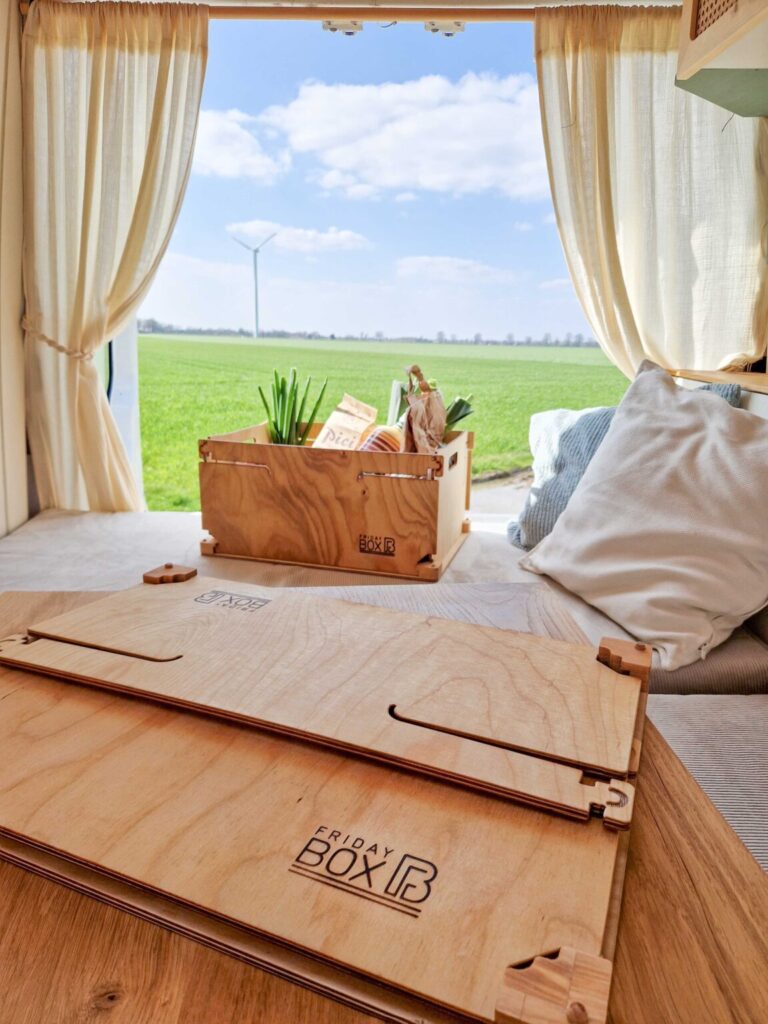
One example is a beekeeper. He uses the boxes first to store his jars of honey and then takes those same boxes directly to the market without repacking. With our trolley, he can unload the boxes from the car or cargo bike, roll them to the stand, and use them there at the same time as a sales counter, shelving, and storage solution.

Another example is a coffee bike in a park. In that context, not only function matters, but also the visual impression at the sales point. The boxes serve as transport containers, but on site they also become platforms, shelves, and storage units, while their wooden appearance supports the overall look and feel.

My personal dream customer is almost someone who does not just need “boxes,” but someone who understands the project as a broader example, namely that you can use existing materials such as wood, together with relatively simple technology, to build very robust, industry-ready solutions. If that leads people to ask, “Do we really need plastic injection molding for everything?” and FridayBOX shows that there is another way, then we have already achieved a great deal.

Kiara: Finally, one last question: what’s next for FridayBOX? How do you see the future of sustainable packaging, and what role do you hope your company will play in it?

Michael: It is not an easy phase at the moment. For example, we have run pilot projects with a major German automotive manufacturer, but the sector as a whole is under considerable pressure. Right now, that means there are not many budgets available for new sustainable packaging systems.

That said, the foldable crate will definitely continue. The ideal scenario would be to be able to make at least part of my living from FridayBOX. We are building the company in a bootstrapped way, without major investors, and developing the product step by step. That also includes a collaboration with a distribution partner that has a very carefully selected product portfolio. To me, that feels almost like receiving another award, because it means FridayBOX is being placed in a curated, high-quality environment.

In terms of development, we want to continue lowering the price, move toward bio-based materials as soon as practical panel materials and adhesives become available, and develop further ideas within this same space: durable, repairable, aesthetically appealing reusable solutions.

Winning the German Packaging Award has already shown that the concept resonates. The award specifically highlighted wood as a renewable raw material, the intelligent folding and locking mechanism, and the product’s long service life. I hope that FridayBOX can continue to serve as a visible example of what sustainable packaging can look like in everyday use, in logistics processes, and directly at the point of sale.
[German Version]

FridayBOX ist ein Social Business aus Deutschland und ein starkes Beispiel dafür, wie wiederverwendbare Verpackungen kreislauffähiges Design, natürliche Materialien und inklusive Produktion verbinden können.

Einstieg 

Dieser Artikel ist Teil der Interviewreihe Circular Impact Champion der Circular Impact Procurement Initiative (CIPI). Darin stellen wir gemeinwohlorientierte Unternehmen mit zirkulären Lösungen vor, die ökologische und soziale Wirkung erzielen. In jeder Ausgabe führen wir ein Gespräch mit Gründerinnen oder Entscheidungsträgerinnen, die neue Wege für die Kreislaufwirtschaft in der Beschaffung und in Lieferketten beschreiten. 

Im Rahmen der Circular Impact Procurement Initiative CIPI unterstützen wir innovative, gemeinwohlorientierte Unternehmen, die zirkuläre Lösungen anbieten und damit gesellschaftlichen und ökologischen Fortschritt vorantreiben. Eines dieser Unternehmen ist FridayBOX, ein Unternehmen, das langlebige, faltbare Holzkisten für wiederverwendbare Verpackungssysteme entwickelt. Die Boxen sind für Logistik-Kreisläufe, den Einzelhandel und den Einsatz am Point of Sale konzipiert und ersetzen Einwegverpackungen durch robuste, reparierbare und platzsparende Alternativen aus Holz.

Unsere Programmdirektorin bei Yunus Environment Hub und CIPI-Verantwortliche, Kiara Winona Sweeney, hat sich kürzlich mit Michael Vitz, dem Gründer von FridayBOX, zu einem Gespräch getroffen. Im Interview erklärt Michael, wie die Idee zu FridayBOX entstanden ist, wie das Unternehmen Prinzipien der Kreislaufwirtschaft durch reparierbares Design und wiederverwendbare Logistik-Kreisläufe umsetzt und wie die Produktion in Zusammenarbeit mit einer Werkstatt für Menschen mit Behinderung soziale Wirkung mit ökologischem Mehrwert verbindet.

Interview 

Kiara: Was ist die Geschäftsidee hinter FridayBOX? Welches Problem löst ihr damit, und was hat dich inspiriert, dieses Unternehmen zu gründen?

Michael: Die Idee ist aus einem Beratungsauftrag entstanden. Es sollte eine stabile, robuste Klappbox gefunden werden, weil schwere Güter im Bereich „letzte Meile“ transportiert werden sollten. In diesem Umfeld habe ich gemerkt: Es gibt nicht viel, was wirklich robust ist – und schon gar nichts aus Holz oder mit einem Look, der an Holz erinnert.

Da habe ich gedacht: Das ist eine Lücke, da könnte man reingehen. Ich habe dann in meiner Prototypenwerkstatt angefangen zu tüfteln und relativ schnell hat sich ein Konzept gezeigt, bei dem ich dachte: Ja, das könnte tatsächlich gut funktionieren. So ist die FridayBOX entstanden – eine stabile, faltbare Holzkiste, die man immer wieder verwenden kann und die sich an unterschiedliche Einsatzzwecke anpassen lässt.

Im weiteren Verlauf hat sich herausgestellt, dass wir die ersten sind, die eine Klappkiste aus Holz entwickeln, die auch für den industriellen Bereich taugt. Wir können die Abmessungen flexibel anpassen – wir bauen heute Kisten etwa von 30 × 40 cm bis hin zur Palettengröße 1200 × 800 oder 1200 × 1000 mm. Damit können Unternehmen schon bei kleineren Stückzahlen maßgeschneiderte Mehrweg-Verpackungen bekommen, ohne gleich in teure Spritzguss-Werkzeuge investieren zu müssen.

Kiara: FridayBOX basiert auf den Prinzipien der Kreislaufwirtschaft. Wie integriert ihr diese Prinzipien konkret in euer Geschäftsmodell, und welche Strategien zeichnen euren Ansatz besonders aus?

Michael:  Wir versuchen, eine Box zu bauen, die wenig fossile Ressourcen nutzt, lange lebt, sich reparieren lässt, und am Ende ihres Lebens als Rohstoff nicht einfach verloren ist.

Die wichtigsten Punkte sind:

  1. Materialwahl: Wir nutzen Birkensperrholz (Multiplex) aus Europa. Nicht jedes Sperrholz ist geeignet – Pappel ist z. B. zu splittrig, Buche verzieht sich oft stark. Birke ist technisch sehr gut geeignet: stabil, formstabil und trotzdem relativ leicht. Die Oberfläche behandeln wir mit Leinöl. Leinöl wird seit Jahrhunderten verwendet, es zieht tief in das Holz ein und härtet aus, sodass die Holzstruktur offen bleibt, aber vor Feuchtigkeit geschützt ist. Wir geben etwas Orangenöl dazu, damit es schneller trocknet.​
  2. Design for Repair: Die FridayBOX ist verschraubt, nicht verleimt. Das heißt: Wenn ein Teil kaputt geht, muss man nicht die gesamte Box entsorgen, sondern kann einzelne Komponenten austauschen. Mit einem Torx-Bit und etwas handwerklichem Geschick ist die Box reparierbar – das verlängert ihre Lebensdauer deutlich.
  3. Faltbarkeit und Nutzung in Loops: Die Box lässt sich extrem flach zusammenklappen – auch  die großen Modelle sind im gefalteten Zustand nur 33 mm hoch. Das spart Platz im Lager und beim Rücktransport. In Mehrwegsystemen, in denen Boxen zwischen Lieferanten und Produktion oder zwischen Lager und Verkaufsstelle zirkulieren, ist das enorm hilfreich: Weniger Leerraum bedeutet weniger Transporte und geringere Emissionen.​
  4. Holznutzungskaskade: Beim Werkstoff selbst sind wir noch nicht da, wo wir gerne wären. Multiplex besteht aus Holzlagen, die mit Leim verpresst werden. Die heute marktüblichen Kleber sind weder kompostierbar noch so, dass man das Material problemlos in einen biologischen Kreislauf zurückgeben könnte. Die Industrie arbeitet zwar seit einigen Jahren an biobasierten und biologisch abbaubaren Klebstoffen, aber das ist noch nicht breit verfügbar.​

Was wir aber tun können, ist die Nutzungskaskade von Holz mitzudenken: Defekte Teile müssen nicht direkt verbrannt werden. Man kann sie schreddern, daraus zunächst Spanplatten machen (die kennt jede:r vom IKEA-Regal), und aus diesen Spanplatten lassen sich in einem weiteren Schritt MDF- oder HDF-Platten herstellen – das ist z. B. die typische Rückwand eines Schranks. So wird der Rohstoff mehrfach stofflich genutzt, bevor er am Ende energetisch verwertet wird.

Unser Ziel ist, die FridayBOX Schritt für Schritt noch kreislauffähiger zu machen – perspektivisch mit biobasierten Klebern und Plattenmaterialien, wenn diese in vernünftigen Preis- und Qualitätsbereichen verfügbar sind.

Ökologische Wirkung: FridayBOX vs. Einwegboxen

Kiara: Dein Produkt zielt eindeutig darauf ab, die Umwelt zu schonen. Kannst du näher auf die ökologischen Auswirkungen eingehen? Wie schneidet die Nutzung der FridayBOX im Vergleich zu herkömmlichen Einwegboxen ab – was ist der Unterschied?

Michael: Wenn man es ganz einfach sagt: Eine FridayBOX ist dafür da, viele, viele Transporte zu überleben. Eine Einwegbox ist nach einem Einsatz Geschichte.

Wir schauen vor allem auf die kommerzielle Nutzung in Logistik-Loops. Ein großer Vorteil ist, dass wir die Box customizen können –  und das nicht nur in der Höhe. Damit kann man Packdichten verbessern: Es passt mehr Ware in eine Box, und dadurch auch mehr auf eine Palette oder in ein Fahrzeug, ohne dass es ergonomisch oder logistisch unpraktisch wird.

Bei klassischen Kunststoffbehältern ist das sehr viel aufwendiger. Wenn man da z. B. die Höhe ändern will, bräuchte man ein neues Spritzgusswerkzeug – das ist enorm teuer. Alternativ wären Speziallösungen nötig, etwa über Schweißkonstruktionen, die aber schnell in Richtung Einzelstücke gehen. Unsere Boxen lassen sich mit vergleichsweise einfacher CNC-Technik und einem Standard-Holzwerkstoff fertigen.​

Ein zweiter Punkt ist die Faltbarkeit:

  • Aufgerichtet sind die großen Boxen etwa 40 × 60 × 24,5 cm groß und tragen rund 48 Liter Volumen.​
  • Zusammengeklappt sind sie nur 33 mm hoch und lassen sich extrem platzsparend stapeln.​

Das macht im Lager- und Rücktransport einen echten Unterschied – auch gegenüber vielen anderen Klappboxen am Markt, die im gefalteten Zustand höher bauen.

Natürlich kostet das Produkt mehr als ein einfacher Karton oder eine dünne Plastikkiste. Das liegt am Rohstoff Holz, an der Verarbeitung und daran, dass wir in Deutschland fertigen. Auf viele Einsätze gerechnet verändert sich die Rechnung aber: Eine FridayBOX ersetzt über ihre Lebensdauer eine große Zahl von Einwegboxen. Damit sparen wir laufend Ressourcen und vermeiden Verpackungsmüll – bei stabilerem Produktschutz, weil Holz deutlich robuster ist als dünner Karton.

Kiara: Über die Vorteile für die Umwelt hinaus ist FridayBOX ein gemeinwohlorientiertes Unternehmen. Welche sozialen Auswirkungen strebst du mit eurem Unternehmen an?

Michael: Ein wesentlicher sozialer Aspekt ist unsere Zusammenarbeit mit einer Werkstatt für Menschen mit Behinderung. Seit Anfang 2023 produzieren wir auf unseren eigenen Maschinen in den Varius Werkstätten, die zur Lebenshilfe im Rhein-Kreis Neuss gehören.​

Ich war zu Beginn der Serienproduktion mehrere Wochen täglich vor Ort, habe die Kolleg:innen intensiv begleitet, sie mit der Frästechnik, der Software und den Abläufen vertraut gemacht und viele Tricks weitergegeben – und selbst auch viel gelernt.​

Mir war wichtig, dass dort nicht nur „Restarbeiten“ landen, also monotone Nacharbeiten oder Tätigkeiten ohne sichtbaren Sinn. Bei der FridayBOX ist es anders: Wir  bekommen die Holzplatten, die Schrauben und das Leinöl, und daraus entsteht vor Ort ein vollständiges Produkt. Die Mitarbeitenden sehen den gesamten Prozess – vom Rohmaterial bis zur fertigen Box.

Ein weiterer Punkt ist, dass nicht nur betreuende Fachkräfte, sondern auch Mitarbeitende mit Behinderung die CNC-Technik bedienen. Gerade für diejenigen, die computeraffin sind, ist das ein echter Entwicklungsschritt. Sie arbeiten in einer Schreinerei und zugleich täglich mit moderner Computer- und Maschinentechnik.

Auch bei Themen wie Oberflächenbehandlung achten wir darauf, dass der Prozess für die Menschen vor Ort gut handhabbar bleibt: Naturöle statt komplexer Industriechemie, klare, einfache Arbeitsschritte – ohne dass man Ingenieur sein muss, um an diesem Produkt mitarbeiten zu können.​

Ich sehe das Projekt auch als Beispiel: dass es möglich ist aus vorhandenen Werkstoffen wie Holz mit relativ einfacher Technik sehr robuste, industrietaugliche Lösungen zu bauen. So kann die FridayBOX zeigen, dass wir anspruchsvolle funktionale Konstruktionen auch mit natürlichen Materialien herstellen können und wir nicht für alles eine Lösung aus Kunststoff-Spritzguss brauchen

Kiara: Wer kann deiner Meinung nach am meisten von deiner Lösung profitieren? Beschreibe deinen idealen Kunden – und kannst du ein paar Beispiele nennen, wie Kunden eure wiederverwendbaren Verpackungen einsetzen?

Michael: Man braucht für die FridayBOX einen passenden Anwendungsfall. Ideal ist ein geschlossener Logistikloop, in dem die Boxen zirkulieren – zum Beispiel zwischen Lager und Marktstand oder zwischen Produktion und Verkaufsfläche. Und man sollte die Klappbarkeit wirklich nutzen wollen. Wenn das alles nicht gegeben ist, reicht oft eine Standardkiste.

Dazu kommt der ästhetische Faktor: Die FridayBOX liegt optisch deutlich über einer üblichen Holzkiste oder einer Kunststoffbox. Das ist besonders spannend, wenn die Box nicht nur im Lager steht, sondern direkt am Point of Sale sichtbar ist.

Ein Beispiel ist ein Imker: Er nutzt die Box zunächst zur Lagerung seiner Honiggläser und fährt dann ohne Umzupacken mit denselben Kisten auf den Markt. Mit unserem Trolley kann er die Boxen aus dem Auto oder vom Lastenrad holen, bis zum Stand rollen und hat dort gleichzeitig Verkaufstheke, Regale und Lagermöglichkeit.​

Ein anderes Beispiel ist ein Coffeebike in einem Park. Dort zählt neben der Funktion auch der Look am Verkaufsstand. Die Boxen dienen als Transportbehälter, werden vor Ort aber auch als Podeste, Regale und Stauraum genutzt – und unterstützen mit der Holzoptik das Gesamtbild.​

Mein persönlicher „Traumkunde“ ist fast jemand, der weniger „nur Kisten“ braucht, sondern jemand, der das Projekt als Beispiel versteht: dass man aus vorhandenen Werkstoffen wie Holz mit relativ einfacher Technik sehr robuste, industrietaugliche Lösungen bauen kann. Wenn dann die Frage gestellt wird: „Brauchen wir wirklich für alles Plastikspritzguss?“ – und die FridayBOX zeigt, dass es auch anders geht, dann ist viel gewonnen.

Kiara: Zum Schluss noch eine Frage: Wie geht es weiter mit FridayBOX? Wie siehst du die Zukunft nachhaltiger Verpackungen und die Rolle deines Unternehmens dabei?

Michael: Es ist gerade keine einfache Phase. Wir haben zum Beispiel mit einem großen deutschen Automobilhersteller Piloten gemacht, aber die Branche ist insgesamt stark unter Druck. Da werden im Moment nicht viele Budgets für neue, nachhaltige Verpackungssysteme frei.

Trotzdem: Es wird auf jeden Fall weitergehen mit der Klappkiste. Traumziel wäre, zumindest teilweise von der FridayBOX leben zu können. Wir arbeiten „bootstrapped“, also ohne große Investoren, und entwickeln das Produkt Schritt für Schritt weiter. Dazu gehört auch eine Kooperation mit einem Vertriebspartner mit sehr ausgewähltem Sortiment – für mich fühlt sich das ein bisschen an wie ein weiterer Preis, weil die FridayBOX damit in einem kuratierten, hochwertigen Umfeld landet.

Inhaltlich möchten wir den Preis weiter senken, auf biobasierte Materialien umsteigen, sobald es praktikable Platten und Kleber gibt, und weitere Ideen entwickeln, die in dieses Spektrum passen: langlebige, reparierbare, ästhetische Mehrweg-Lösungen.

Die Auszeichnung mit dem German Packaging Award hat schon gezeigt, dass das Konzept ankommt: Holz als nachwachsender Rohstoff, ein intelligentes Falt- und Verriegelungsprinzip und eine lange Nutzungsdauer wurden dort hervorgehoben. Ich hoffe, dass wir mit FridayBOX ein sichtbares Beispiel dafür bleiben, wie nachhaltige Verpackung aussehen kann – im Alltag, in Logistikprozessen und direkt am Point of Sale.​