
Social business models and circular solutions can help companies reduce dependencies, keep more value in their value chains and stay strong through disruption. That takes system change, and people with the agency to lead it.
Co-authors: Harald Friedl, Christina Jäger, Kiara Winona Sweeney
Key takeaways
Climate disruption is exposing resource dependencies and vulnerabilities across value chains, making resilience an increasingly important business priority.
Circular solutions and Social Business models show how companies can reduce dependencies while creating economic, environmental and social value.
Scaling these approaches requires more than successful pilots. Procurement, finance, policy and partnerships need to create markets in which solutions can grow.
As AI accelerates everything around us, the scarce resource is human: leaders with the agency, coherence and integrity to act on what they already know.

Imagine the future as an open page that we co-create in every single moment, through what we buy, build, fund and allow.
This summer alone brought wildfires across North America and Europe, drought-stricken river basins in South America and southern Africa, and devastating floods in Nepal. Different events, but a shared reminder: communities and businesses depend on systems that can be disrupted rapidly and simultaneously.
For business leaders, the practical question is how to stay competitive when resources, infrastructure and operating conditions become less predictable.
That challenge sits alongside technological change, geopolitical uncertainty and pressure on investment. Yet the response cannot be to postpone every decision until conditions stabilize. Waiting is also a decision, and usually the most expensive one.
Circular business models, inclusive value chains and enterprises designed around social and environmental needs show how companies can create value differently. Yet the system is moving the wrong way. When we launched the Circularity Gap Report in 2018, 9.1% of the materials entering the global economy were cycled back. Today it is 6.9%, and linear practices cost around €25.4 trillion a year, close to a third of global GDP. Better projects alone will not turn that curve. The rules, incentives and markets have to change too. One place to start is circularity.
1. Make circularity a business strategy
Circularity is often discussed through what it reduces: waste, resource consumption and environmental pressure. Its strategic value also lies in what it retains: materials, products, capabilities and customer relationships.
Repair, reuse, refurbishment and remanufacturing can give companies alternatives to continuously sourcing new inputs. Service-based models can create revenue through product performance and continued use, rather than sales volume alone.
A 2026 World Economic Forum and Bain & Company survey found that 80% of executives consider circularity important to their business, with that share expected to reach 94% within three years. But recognition does not automatically lead to investment. This gap between intention and action is where most circular strategies stall. A circular model still needs to meet customer expectations, operate reliably and demonstrate its economic value.
The leadership task is therefore to identify where circularity solves a concrete business problem: where value is lost, where dependencies create risk, or where recovery and reuse could improve the customer offering. Start with one product line, one material flow or one customer, and make the numbers visible.

2. Design resilience around people
Resource resilience is only part of the equation. Stronger businesses also depend on people: who can access a solution, who benefits economically, who gains skills and employment, and who participates in the value created.
This is where Social Business offers a useful model. In Professor Muhammad Yunus’ definition, a Social Business uses a financially self-sustaining business model to solve a social or environmental problem, reinvesting profits to deepen or scale that impact. The impact sits inside the business model, where it cannot be cut in a bad quarter.
Research by Yunus Environment Hub and Bertelsmann Stiftung shows how this principle can translate into circular business models through employment, affordability, education, inclusion and stronger local economies.
Yunus Environment Hub’s CirculaRise Accelerator shows how this can work in practice:
Re-Root-Tex transforms discarded pineapple leaves into textile fibres while creating economic opportunities in rural communities. The company reports creating 75 jobs for women in rural Bangladesh, alongside support such as education for workers’ children.
fainin replaces ownership with access through a digital sharing platform. Users can rent rather than buy products, reducing the cost of access while allowing owners to generate value from underused assets.
Paper Earth turns low-value textile residues into pulp for paper and packaging, creating a new market for material that would otherwise lose value. Its production model in India connects textile waste with existing recycling and manufacturing infrastructure, keeping more value local and reducing demand for virgin fibre.
These approaches are not limited to start-ups. AfB social & green IT shows what the same principle can look like at scale. AfB refurbishes used corporate IT equipment and returns devices to the market while deliberately creating inclusive employment for people with disabilities. In 2025, the company reports processing 728,000 IT and mobile devices, remarketing 71% of them and employing around 700 people across Europe, 49% of whom had disabilities.
These businesses solve different problems but share one principle: social value is designed into the way economic value is created. For established companies the lesson is practical: design value chains around resource needs and human needs together, as one agenda.
There is a second reason to double down on people now. AI is accelerating analysis and design a hundredfold. It can model a circular supply chain in minutes. It cannot decide to build one. That takes people who step into their own agency, act with coherence and lead with integrity when short-term numbers argue for business as usual. Companies that invest in this human capacity will turn technology into transformation. The others will automate the linear economy faster.

3. Build markets that let solutions scale
Promising solutions will not scale through entrepreneurial effort alone. Cost, operational complexity and fragmented ecosystems remain barriers to circularity. These are system barriers. No single company removes them, so buyers, suppliers, financiers and public bodies have to build the conditions together.
Corporate procurement is one place to start. Purchasing decisions can consider durability, serviceability and lifetime cost alongside initial price, while longer-term commitments can give emerging providers greater certainty. Finance also needs to reflect how circular models create value: businesses built around durable assets, recurring services or product recovery may require different investment horizons from conventional sales models.
Scale also depends on coordination. Clearer standards can reduce uncertainty, while better product information and traceability can support recovery and cooperation across value chains. Policy has to do its part: price the value we lose today, and stop rewarding extraction over recovery.
The objective is to establish markets in which effective solutions can become dependable suppliers, services and business partners.

4. Build resilience before disruption hits
Climate shocks will not be the last source of disruption businesses face. Resource constraints, geopolitical uncertainty, technological change and shifting markets will continue to test how companies operate. Resilience therefore belongs in the business model, designed from the start.
For business leaders, resilience means building more options, fewer avoidable dependencies and stronger relationships across the value chain. It also means integrity leadership: saying what you will do, doing it, and reporting honestly on the gap.
5. COP31: From ambition to implementation
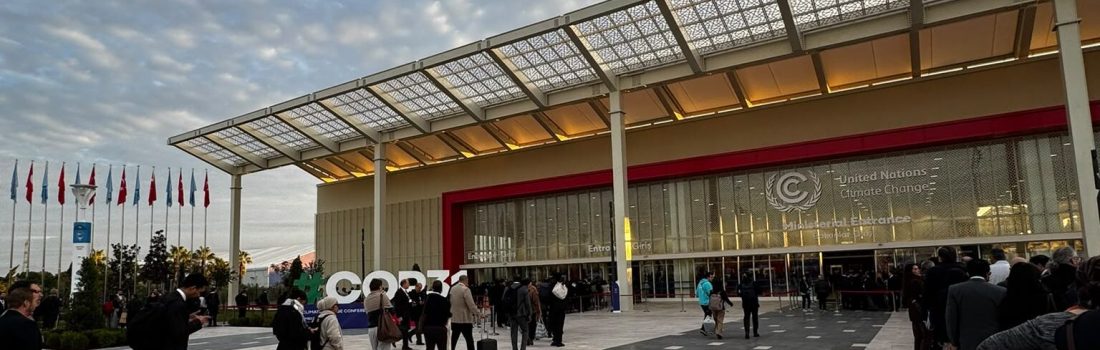
As the world looks ahead to COP31, the priority should not be another cycle of promises that remain disconnected from business reality. What we hope to see is a stronger focus on implementation: policies, financing mechanisms and market signals that make circular and inclusive business models the default rather than the exception. COP31 should accelerate support for climate adaptation and resilience in real economies, particularly through investment in SMEs, circular value chains and Social Businesses that strengthen communities while reducing resource dependency. It should also recognize the role of entrepreneurs and young innovators as solution providers, creating pathways for them to access markets, finance and partnerships at scale. Ultimately, success at COP31 will not be measured by the number of commitments announced, but by whether businesses and communities leave with clearer incentives and practical opportunities to build resilience where it is needed most.
6. What we have seen working: Minimum Viable Ecosystems
Most policy and financial incentives still reward the linear system. Virgin materials are often cheaper than recovered ones, and the cost of extraction and waste rarely shows up in the price. In that setting, a circular solution can be better for everyone and still lose in the market. Making it work can feel like making the impossible possible.
What we have seen work, again and again, is building Minimum Viable Ecosystems (MVEs). An MVE is the smallest group of partners that together can make a circular solution work in real life: a buyer who commits, a supplier who delivers, a financier who accepts a longer horizon, or a public body that removes a barrier. Each partner carries part of the risk and receives part of the value. The MVE proves the model with real contracts and real numbers, then grows by adding partners and markets. It moves in months, while rules and markets take years, and it gives policymakers the evidence to change incentives and investors a track record to back.
Yet no MVE builds itself. In everyone we have seen succeed, a few people decided to act before the conditions were perfect. They took ownership, built trust across organisations that usually compete or ignore each other, and kept their word when it got hard. Ecosystems run on contracts, and contracts are made by people. I have seen it work over and over again: proving that human collaboration can make the impossible possible.

7. So what? What you can do now
Business has the power to shape the future faster than almost any other actor. Here is where to start this year.
As a business: pick the one material flow or product line where linear dependency costs you most, and build an MVE around it with partners from your value chain. Put durability and lifetime cost into procurement, and report honestly on progress and gaps.
As a brand: tell the truth about what you have changed and what you have not changed yet. Invite customers into repair, return and reuse, and make the circular option the easy one.
As a consumer: buy less and better, repair, share and rent. Ask brands where their products go after use. Every purchase is a vote for the system you want to live in.
Many of the solutions already exist. What is missing is the decision to use them at scale, and the courage to change the systems that hold them back.
Resilience will be built by leaders who step into their agency now, and by businesses designed to create value through uncertainty, for people, companies and the planet.